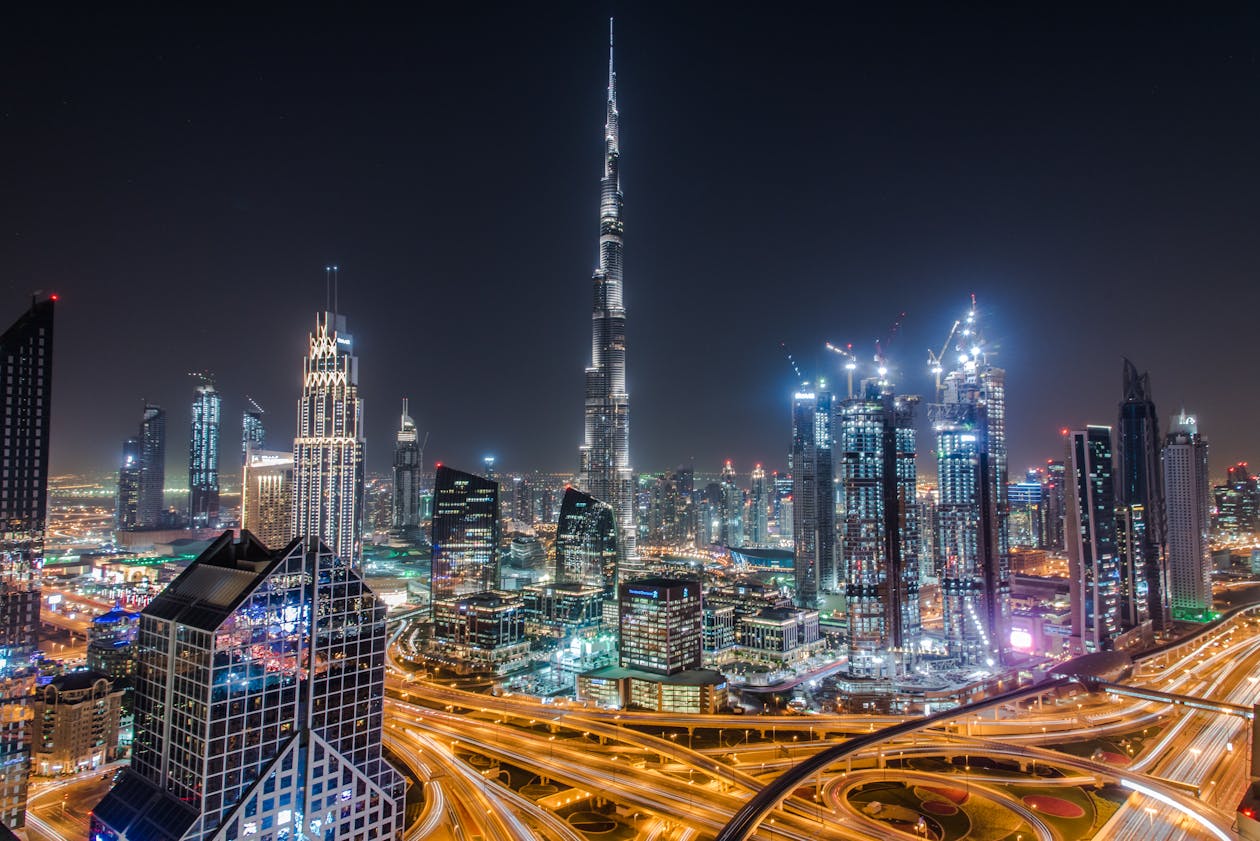
Sheikh Mohammed's approval of the Dh34 billion Dubai Metro Gold Line lands on the strongest quarter Dubai real estate has ever posted — AED 176.7B in Q1 2026, prime residential up 25.1%, and CBRE reporting double-digit office-rent growth despite a regional geopolitical shock. The infrastructure announcement compounds a re-rating that is already underway.
On April 22, Sheikh Mohammed bin Rashid approved the Dubai Metro Gold Line — a Dh34 billion (US$9.3 billion), fully underground, 42-kilometre extension of the city's driverless metro. 18 stations. 15 strategic districts. An interchange with Etihad Rail. 1.5 million residents in the catchment. Tendering in 2026, awards in 2027, revenue service in 2032.
Those are the headline parameters. But the real Dubai Metro Gold Line investment thesis isn't about the line itself — it's about what a $9.3B infrastructure announcement does to a market that is already repricing.
Q1 2026 closed at AED 176.7 billion across 47,996 transactions — +23.4% year-on-year in value, off-plan at 70% of volume and 71% of value. Knight Frank's 2026 Wealth Report clocked Dubai prime residential at +25.1% in 2025, versus a 3.2% global prime benchmark. CBRE's Q1 review reported +14% Dubai office rents, +16% prime office rents, and ~95% occupancy — all during a quarter that began with a regional geopolitical shock.
The macro tape is stressed. The market tape is not. And an infrastructure announcement at this scale, arriving on that data set, is not a marketing moment. It is a structural re-rating event.
What's Actually Inside the Dubai Metro Gold Line Investment Case
The Gold Line is not an incremental expansion. It is the most economically consequential civic-infrastructure announcement in Dubai since the original Red Line broke ground in 2005.
The hard parameters:
- Budget: AED 34 billion / US$9.3 billion, fully underground.
- Length: 42 kilometres, extending Dubai Metro's total network meaningfully.
- Stations: 18, including interchanges that knit the Gold Line into the Red Line, Blue Line, and the future Etihad Rail corridor.
- Catchment: 15 strategic districts — Business Bay, Meydan, JVC, Dubai Science Park, Motor City, Dubai Silicon Oasis, and others that have historically traded at a transit discount.
- Served population: 1.5 million residents.
- Schedule: tendering in 2026, contract awards in 2027, revenue service in 2032.
Developer and brokerage commentary published inside 48 hours of the announcement converged on a tight range of forward projections for station-adjacent property: 10–25% uplift in prices and 15–30% uplift in rents by the time the line opens, with meaningful front-loading during the construction cycle.
Those numbers aren't aspirational. They track the empirical precedent from the Red Line.
Properties located within an 800-metre walk of an existing Dubai Metro station have historically traded at a 20–30% premium to comparable non-adjacent stock, with a 18–25% capital-value appreciation profile during the construction window and further upside post-opening. The Gold Line is the playbook running again, on a longer line, through denser-trafficked districts, at higher entry prices.
For an allocator, the interesting window is the construction cycle itself — not the ribbon-cutting. Transit premiums price in well before trains run. The re-rating of JVC in the 2009–2012 Red Line cycle, of JLT in the Marina spur, and of Expo City during the 2020 delivery push all show the same pattern: the first and largest re-rate happens between announcement and topping out, not between opening and stabilisation.
Why the Timing Is Doing the Heavy Lifting
The Gold Line was announced into the strongest quarterly data Dubai real estate has ever posted.
From the Dubai Land Department's Q1 2026 figures (via Gulf News and construction-sector reporting):
- Q1 2026 transaction value: AED 176.7 billion — +23.4% year-on-year.
- Q1 2026 transaction volume: 47,996 — +5.5% year-on-year.
- Off-plan share: 70% of volume, 71% of value — up from 55% in 2024.
- January 2026 alone: AED 72.4 billion, the largest single month in DLD history.
- Q1 2026 mortgage transactions: 11,829, value AED 59.8 billion, +46% year-on-year in value.
- Primary-market median villa price: AED 4.1 million, +35.3% year-on-year.
Volume grew 5.5%. Value grew 23.4%. That gap is the signal — average ticket sizes are climbing materially, which is how you know the buyer pool is mixing upward, not sideways. The same dataset that shows transaction count growing in single digits shows mortgage value growing at six times the rate of mortgage count. Bigger loans, against more expensive units, in a qualifying pool that is shifting from cash-heavy internationals to mortgage-qualified global residents.
A $9.3B infrastructure announcement lands differently into that market than into a flat one. In a flat market, an infrastructure catalyst has to generate its own momentum. In this market, it compounds existing momentum.

Knight Frank's 2026 Wealth Report: The Capital-Flow Confirmation
If the Q1 transaction data shows that the market is being repriced, Knight Frank's 2026 Wealth Report shows who is doing the repricing.
The key readings:
- Dubai prime residential prices: +25.1% in 2025, second-fastest globally. Global prime benchmark: +3.2%. Dubai grew roughly 8x the global average.
- Cumulative five-year Dubai prime growth: +193.9%.
- Super-prime transactions: ~500 residential deals above $10 million, retaining Dubai's lead as the world's most active ultra-prime market.
- Total 2025 Dubai transaction value: AED 544.2 billion, +25% year-on-year.
- UAE ultra-high-net-worth population: 4,851 individuals in 2026, projected to reach 6,588 by 2031 — +36% growth.
- Knight Frank's 2026 outlook: +3% prime, +1% mainstream.
Pair those two numbers — 25.1% Dubai prime growth against a 3.2% global benchmark — and the capital-flow narrative writes itself. UHNW buyers are parking wealth in a USD-pegged, tax-efficient, internationally-connected jurisdiction at the precise moment that UK, US, and Canadian source markets are digesting higher CGT, deeper estate-tax exposure, and sustained rate volatility. Prime Dubai is being underwritten as the new Monaco, not as an emerging alternative to Miami.
Knight Frank's 2026 forecast is intentionally conservative on prime (+3%) relative to the 25% it just measured — but even at that base case, the implied ultra-prime tailwind remains decisive: capital destined for Dubai is already allocated. The committee decisions have been made. The Gold Line just added an infrastructure amenity to the thesis.
The CBRE Stress Test: A Market That Refused to Break
The single most important Q1 2026 data point for allocators isn't in the transaction feed. It's in the CBRE Q1 2026 UAE Real Estate Market Review.
The March geopolitical shock should have, by every textbook, compressed demand, widened spreads, and softened rents. It didn't:
- Dubai office rents: +14% year-on-year, prime at +16%.
- Dubai office occupancy: ~95%.
- Abu Dhabi office rents: +12% year-on-year, occupancy at ~98%.
- Development pipeline through 2027: limited, keeping conditions tight inside regulated business zones.
- Industrial and logistics: rents and occupancy held firm; absorption remained demand-led.
- GCC sovereign bond spreads: tightened during the quarter, not widened.
CBRE's explicit framing: UAE real estate absorbed the shock without cracking. Supply is structurally tight. Occupancy is near-ceiling. Rent growth is double-digit across both emirates. And capital markets — measured through the sovereign-bond spread — narrowed during a quarter most global allocators expected to see a widening.
When a market's macro prints weaken, its geopolitical tape deteriorates, and its office rents, occupancy, and sovereign spreads all move the wrong direction for the bears, you are no longer modelling a cyclical market. You are modelling a structurally supply-constrained one. That's the institutional checkpoint this cycle needed to clear, and the CBRE review is the cleanest data point confirming it cleared.
The Diversification Dividend Underneath the Thesis
For any allocation committee still filing Dubai under "oil economy, geopolitical risk, cyclical," the 2026 qualitative reset is overdue.
The Khaleej Times diversification review published April 22 reads like a dossier built for allocator pushback:
- Over 95% of Dubai's GDP is now non-oil — one of the most aggressive economic diversifications on record.
- 40+ free zones, offering 100% foreign ownership and zero repatriation tax.
- Tourism as a direct contributor of roughly 20% of GDP, supported by Emirates, Flydubai, DXB, and the Al Maktoum expansion.
- Logistics backbone anchored by Jebel Ali, now the single largest port in the Middle East and a top-10 container port globally.
- A financial-services stack spanning DIFC and ADGM, with institutional inflows that have repeatedly outpaced forecasts for four consecutive years.
This is the qualitative narrative that pairs with the CBRE and Knight Frank prints. The city is not an oil economy. Real estate here is a derivative of trade, tourism, and financial services — not of Brent crude. Which Western city offers this policy stack, this tax architecture, this population-growth curve, and a $9.3B infrastructure announcement in the same month? The answer, for 2026, is none.

Three Positioning Questions for 2026 Allocators
The Gold Line, the Knight Frank data, the CBRE resilience read, and the diversification dossier compress into three underwriting questions worth running through every Dubai allocation model right now.
1. Is your Dubai exposure priced for a transit-upgraded or pre-transit corridor?
The 15 districts in the Gold Line catchment are not uniformly priced. Some already carry a connectivity premium. Others — particularly the JVC and Silicon Oasis nodes — still trade at effective transit discounts. The 2026–2029 window is where that gap closes. If your model assumes a flat forward curve on these corridors, it is underwriting the wrong line.
2. Does your thesis separate geopolitical risk from capital risk?
CBRE's Q1 2026 print is the cleanest answer the market has given to that question in 18 months. Office rents up double digits, occupancy near ceiling, bond spreads tightening during a quarter that opened with a regional shock. If a 2026 committee memo still conflates headline risk with capital risk in the UAE, it is working off a 2019 dataset.
3. If prime Dubai is the new Monaco, how much of your global real-asset book is already there?
25.1% prime growth against a 3.2% global benchmark is not a one-quarter anomaly. It is the fourth consecutive year of Dubai prime outperformance, underwritten by a UHNW migration pipeline that Knight Frank projects to grow +36% by 2031. The Gold Line compounds the story. The diversification stack insulates it. The CBRE stress test confirmed it.
Reach out if you're evaluating how to size Dubai exposure against this data set — happy to walk you through the corridor-level underwriting and the segment-by-segment case behind this analysis.
Sources: Khaleej Times — Dubai Metro Gold Line property and rent impact (April 23, 2026); Gulf News and Khaleej Times — Dubai Metro Gold Line route map, station count, and Dh34 billion project announcement (April 22, 2026); Gulf News — Dubai Q1 2026 property sales AED 176.7 billion and off-plan 70% (April 2026); Knight Frank 2026 Wealth Report — Dubai prime residential +25.1%, 500 super-prime transactions, UAE UHNW forecasts (Q1 2026); CBRE Q1 2026 UAE Real Estate Market Review — office rents, occupancy, market resilience (April 22, 2026); Khaleej Times — Why UAE and Dubai fundamentals continue to outperform global uncertainty (April 22, 2026); Economy Middle East — UAE office market Q1 2026 rent growth (April 2026).